Massage for Older Travellers in Bangkok
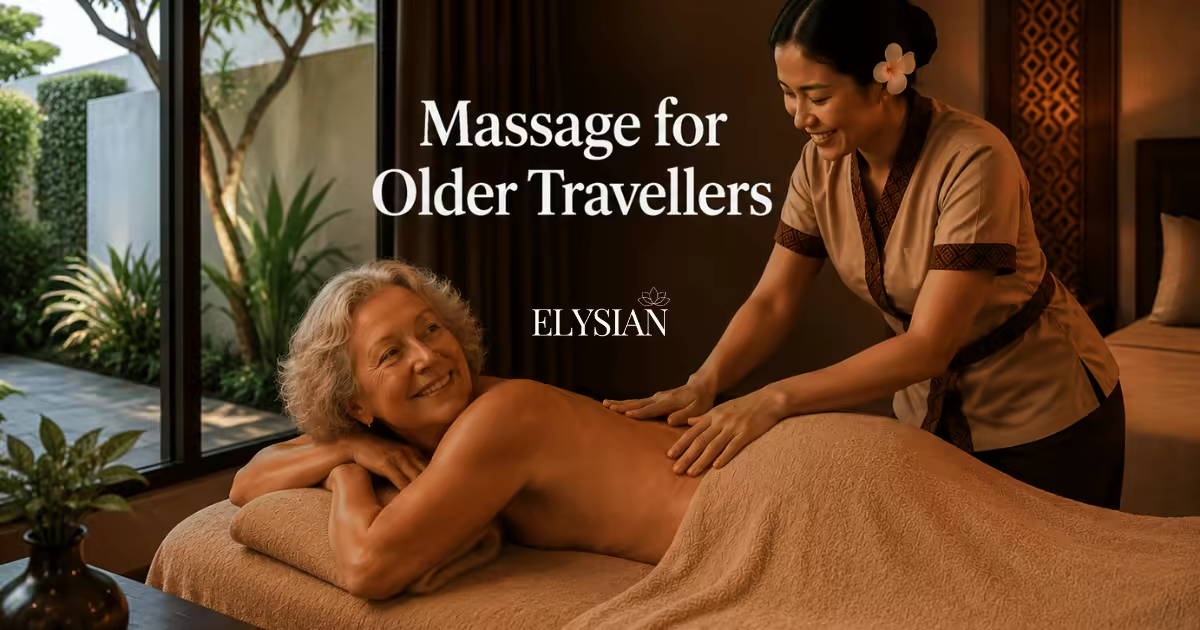
A good massage adapts to the body on the bed, and for an older traveller that means a few sensible changes: lighter pressure, gentler and smaller stretches, extra support under the knees and neck, and no climbing onto a high spa table. Massage for older travellers is less about a special technique and more about a therapist adjusting the ordinary one to suit you. Done that way, it is one of the nicest things you can do for a tired body after a day of sightseeing, and an in-room session in your own hotel room is often the easiest way to have it.
Older travellers are a large and active group. In Europe, people aged 60 to 74 generated 23% of trips for private purposes and 26% of tourism nights, while making up 21% of the population aged 15 and over, according to Eurostat, so they travel more than their share, not less. This guide covers how to get a massage that fits an older body. Whether it is safe for you is a separate question, and our guide on who should not get a Thai massage covers who should skip it or ask a doctor first.
- Lighter pressure, especially over thin skin and bony areas
- Smaller, slower stretches kept within your range, or none at all
- Extra pillows under the knees, neck, and ankles for support
- The massage on your own hotel bed, not a high spa table
- Whatever length suits you, from a shorter session to a full hour
- Tell the therapist your age and any conditions when you book
What a gentle massage does for an older body
You do not have to earn a massage with a hard one, and an older body often gets the most from the gentlest version.
After a long flight or a day of walking around Bangkok, muscles stiffen and joints feel tight, and a slow, light massage eases that without strain. It leaves you moving more easily, resting better that night, and simply feeling looked after, which counts for a lot when you are far from home. None of it needs deep pressure or big stretches. The value is in the warmth, the unhurried touch, and the time spent easing a tired body, not in how hard the therapist works. For an older traveller, gentle is not a compromise. It is the point.
The main adjustment is lighter pressure
For most older bodies, the single change that matters is pressure, and a good therapist makes it without being asked twice.
Skin thins with age, joints and bones are more delicate, and the cushioning layer of fat under the skin reduces. MedlinePlus, from the US National Library of Medicine, notes that with age skin becomes thinner, less elastic, and more fragile. So the firm, deep pressure that suits a younger back can be too much for an older one. The fix is simple: lighter, slower strokes, with extra care over bony areas and thin skin. You still get the benefit, the eased muscles, the better circulation, the calm, without the force. If anything feels too strong, say "softer," and it changes at once. You set the pressure, not the therapist.
Gentler stretching, or none at all
Traditional Thai massage is known for its stretches, and those are the part that needs the most care with an older body.
A skilled therapist keeps the stretches small, slow, and well within your range, never pushing a stiff hip or knee past where it wants to go. If your joints do not move as freely as they once did, that is exactly the information she needs, so tell her. And if you would rather skip the big stretches entirely, an oil-based treatment like aromatherapy oil massage gives you all the relaxation with none of the yoga-like positions. Our guide to Thai versus oil and Swedish massage explains the difference if you are choosing.
Extra support makes it comfortable
Small comforts make a long difference when you are lying still, and they are easy to arrange.
A pillow under the knees takes the strain off the lower back. A rolled towel or cushion under the neck and ankles keeps everything relaxed. If lying face down is uncomfortable, you can lie on your side with support, which many older guests find easier. None of this is unusual to ask for. A good therapist offers it, and brings extra pillows and towels anyway, but it is worth saying what would make you comfortable when she arrives.
Getting on and off the bed is easier in your room
This is where having the massage come to you quietly wins for an older traveller.
At a spa, you often have to climb onto a raised treatment table, which is awkward with stiff hips, sore knees, or poor balance. An in-room massage happens on your own hotel bed, at a normal height, with the bedside table and headboard right there to steady yourself and the therapist on hand to help. You also skip the trip across Bangkok and the wait in a lobby, which matters on a day when your energy is limited. For anyone who tires easily or moves carefully, that convenience is not a small thing.
Length is your choice
There is no rule that an older traveller needs a shorter massage, only that you should have the length that suits you.
A full 60 minutes is comfortable for most people, and gives time to work the whole body gently. But if lying still that long is not for you, a shorter session is perfectly reasonable, and a good therapist would far rather give you a comfortable 45 minutes than a restless hour. If you are unsure how long feels right, start shorter and book longer next time once you know how your body responds. Book what you think you want, and adjust it on the day.
Tell the therapist what she needs to know
The most useful thing you can do before any massage is also the simplest: speak up about your body.
Mention your age, any conditions like osteoporosis, high blood pressure, a heart condition, or arthritis, any recent surgery, and any joint that does not move well. Name the areas you would like left lighter or left alone. Say it when you book, so the right therapist and approach come to you, and again when she arrives. This is not fussing. It is exactly what lets her tailor the session, and it is the difference between a massage that suits you and one that does not.
When to check with a doctor first
Most older travellers are fine with an adapted massage, but a few conditions call for a doctor's word before you book, not just a lighter touch.
Osteoporosis, a recent operation, uncontrolled blood pressure, a heart condition, or blood-thinning medication are all reasons to ask your own doctor whether massage is suitable for you right now. That is a separate question from how the session is adapted, so check with yours before booking if any of those apply. When your doctor is happy and the treatment is gentle, an older body has as much to gain from a good massage as anyone.
Booking a massage that fits
Age is not a reason to skip a massage on your trip. It is only a reason to have one that is adjusted to you, which any good therapist does as a matter of course.
A licensed therapist can come to your hotel room in about 30 minutes, any day from 10 AM to 2 AM, and work on your own bed with fresh sheets. Message on WhatsApp or LINE with your hotel and room number, and tell us your age and anything we should know, so we send the right therapist for a gentler, well-supported session. You can explore in-room massage in Bangkok first if you would like.
Frequently Asked Questions
Often yes, once it is adapted. A good therapist uses lighter pressure, gentler and smaller stretches, and extra support under the knees and neck, rather than the full, forceful version. What matters most is that the treatment is adjusted to your body and that you have checked any health conditions first. If you have osteoporosis, recent surgery, or a heart condition, read our guide on who should not get a Thai massage and ask your doctor before booking.
A gentle, oil-based massage such as aromatherapy or a soft Swedish-style treatment usually suits an older body best, because it relaxes muscles without strong stretching or deep pressure. Traditional Thai massage can also work well when the therapist keeps the stretches small and the pressure light. Tell the therapist your age and any conditions when you book, so she brings the right approach.
The therapist works with lighter pressure, especially over thin skin and bony areas, uses smaller and slower stretches, and supports the body with extra pillows under the knees, neck, and lower back. Sessions can be shorter if that is more comfortable, and everything is checked with you as it goes. An in-room massage adds one more comfort: you lie on your own hotel bed rather than climbing onto a high spa table.
Lighter, and shorter only if you prefer. Lighter pressure is the main adaptation, since older skin and joints do not need force to benefit. Length is a personal choice: a full 60 minutes is fine for most, but a shorter session is perfectly reasonable if lying still that long is uncomfortable. Say what you want when you book, and adjust it during the session.
It is easier with an in-room massage than at a spa. At a spa you often climb onto a raised treatment table, which can be awkward with stiff hips or knees. In your hotel room the massage happens on your own bed, at a normal height, with furniture nearby to steady yourself, and the therapist there to help. For anyone with limited mobility, that is a real advantage.
Mention your age, any conditions like osteoporosis, high blood pressure, a heart condition, arthritis, or recent surgery, any joints that do not move well, and where you would like lighter pressure. Say it when you book and again when she arrives. A good therapist will adapt the whole session around it, and will happily avoid any area you name.